Anatomy Of A Miracle Born In Faith
Virat Kohli refused to yield as India won a game they should have lost
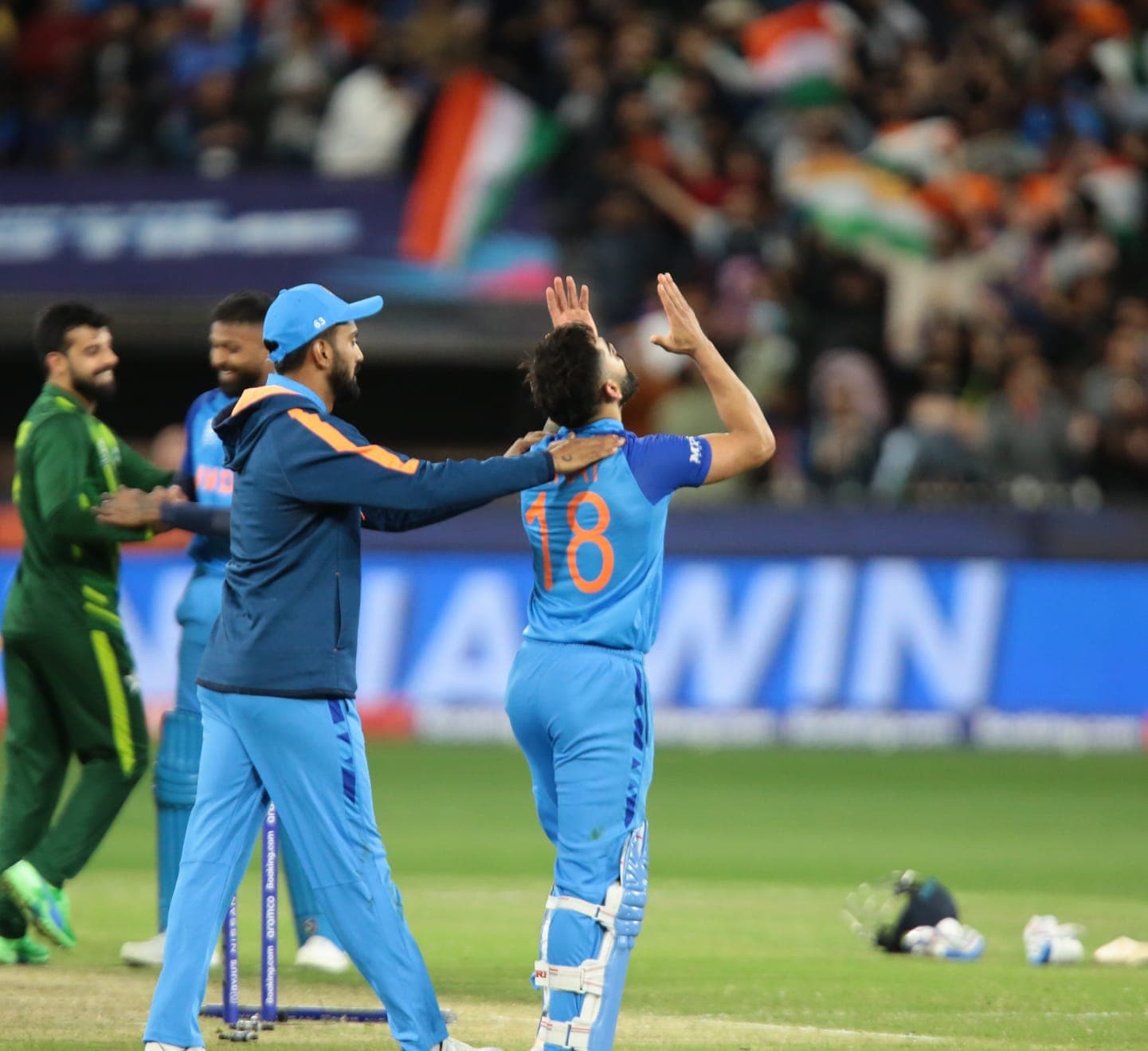
Do you believe in miracles? Do think magic is possible? Do you feel that a greater power is watching over you? All things require one thing in common: blind faith.
You much concede that you do not know everything, put all scepticism aside and work on the premise that certain things are just true, even if there is no scientific evidence to support this.
Virat Kohli takes that faith and channels it into belief in himself.
It is not unfair to say he has struggled in international cricket for a time, in the sense that he has not been able to match the high standards he set earlier. It is a fact to say that he went two years without a century in any format, which is not something the world’s best players do. It is not inaccurate to say that he was finding ways to get himself out, especially outside the off stump.
The combination of these factors, living the bubble life and the stresses that come with it, forced Kohli to give up the Test captaincy and then the T20 captaincy, after which he was relieved of One-Day International leadership duties.
Kohli may have given up the crown, but he never gave up on King Kohli the batsman. When all evidence pointed to his run being more than just bad luck or a temporary slump, he backed himself to do what he thought was best and what he knew best.
Kohli did not go to an ashram to rejuvenate his mind or to a personal batting coach to rebuild his technique: he trusted himself and the game that had got him this far in the first place.
And Pakistan felt the brunt of this at the Melbourne Cricket Ground. Rohit Sharma, India’s captain, had spoken about the need for the middle order to be ready for all situations, in December last year. “Nowhere is it written that if you are 10 for 3, you can’t get to 180, 190 or more. I want the guys to prepare in that fashion. Let's say we are playing the semi-final and we are 10 for 2 in the first two overs, what do we do? What is the plan? I want to put ourselves in that situation again and see if we can respond to that. We have got some games before the World Cup to try and test that out.”
There was no need for the team to be so obliging in their first ball of the T20 World Cup and give the captain the position he had spoken out. And yet, against a quality pace attack, a one-of-a-kind chase was delivered.
At the halfway mark, India were 45 for 4 with Kohli on 12 from 21 balls. This was just not the way to play T20 cricket, no matter how good the bowling was, or how many wickets had fallen. At least that’s what most people watching this game would have thought.
Here was Kohli doing a Mahendra Singh Dhoni, taking the game deep, to the point where the margins become so fine that a couple of dot balls or one mishit could prove fatal.
Kohli conceded that there were times when doubts crept in.
“To be honest, when I was 12 off 21, I was like, I'm really messing this game up, not pulling the ball in the gaps. But then when you have experience then you understand the value of batting deep,” Kohli said at the post-match presentation. “That's always been my role-playing for India, to bat 16-17 overs. Because I know that I can do a lot of the power-hitting towards the latter half of the innings. And that's always been my strength. I can strike at 250-300 as well when I become really confident and there's only one guy under pressure and that's the bowler.”
But it was not just then that things looked done and dusted. Even with Hardik Pandya joining Kohli and taking some pressure off with a couple of clean strikes, India were far behind where they needed to be. And, while the spinners were sneaking their overs in, Kohli and Pandya would have known that they had six overs of serious pace and heat to contend with while needing to score at more than 10 an over.
All this, in a cricket ground where the majority of 90,293 fans expected, even demanded an India win. The atmosphere was undoubtedly electric and the decibel level for the best might have caused damage to delicate eardrums. But, equally marked were the pin-drop silences when an Indian wicket fell or when a Pakistan bowler strung together three good deliveries. It showed just how much on the edge of their seats the paying public was.
At the end of the 17th over the match was still pretty much dead in the water as a contest. India needed 48 from three overs, and Pandya was genuinely struggling. Physically he had been pushed to his limit by Kohli, who ran his partner ragged with quick singles and tight twos, over and over. Mentally, the shots Pandya was trying were not coming off and he was failing to connect far too often for his own comfort.
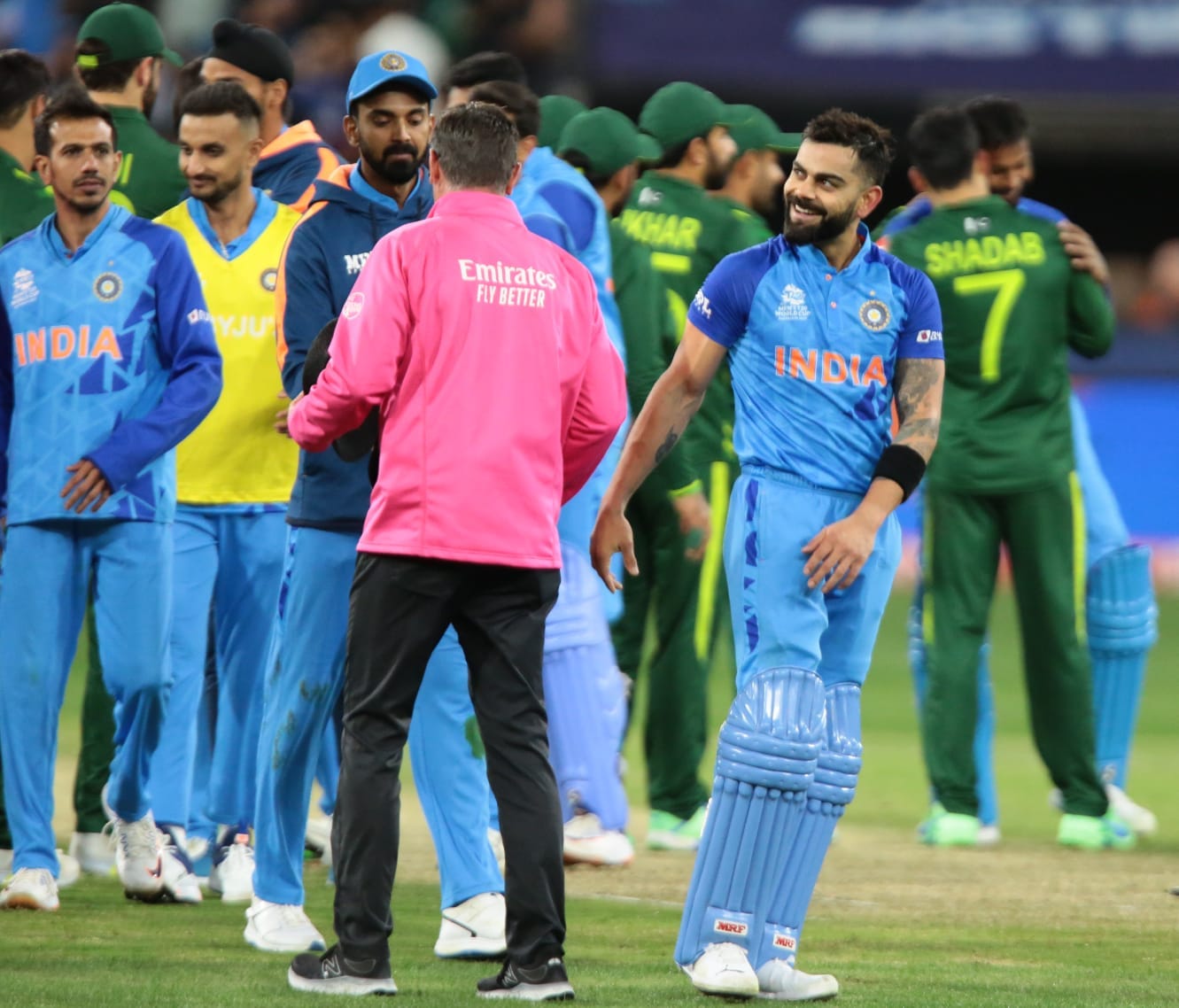
Kohli took on Shaheen Shah Afridi, India’s nemesis from the last World Cup, in the 18th over, finding boundaries through midwicket, cover and fine-leg. Steady pull, lofted drive, swivel hook, Kohli was showing his range. With 17 from the over, India could dream, but 31 from 12 balls is not something you can take for granted.
Haris Rauf was tasked with bowling the penultimate over, the last one of pace in the innings. He had one job, in that he needed to leave Mohammad Nawaz enough runs to defend in the final over.
Rauf was well on his way, conceding only three from his first four balls, taking the equation to 28 off 8 balls. You would have had to have been incredibly brave or very drunk to bet on India at this point.
Then came the shot of the day, match, week, month or year — take your pick. Rauf sent down a back-of-the-hand slower ball that was pitched back of a length, climbing towards bail height, which should have been un-hittable.
But Kohli does not subscribe to such theories. Staying still, weight neither fully back nor forward, he played a straight bat shot over the bowler’s head. Given the ball and the batsman’s position, you might have expected the ball to just about clear the 30-yard circle, instead, it went over the ropes and just kept going. This defied all logic, but then again, this was Kohli and the shot was powered by instinct and belief. Obviously, just that is not enough, but champions stay cool at the biggest moments and possess skills that others can only aspire to.
The next ball was easier to deal with. Slipping down leg, Rauf gave Kohli a way out. All the batsman needed to do was make good contact, which Kohli did perfectly and half a dozen more was added to India’s account, this timesaver fine-leg.
Now, now, now. Only 16, and this can be said in the context of the chase up until then, only 16 was needed from the final over, which would be bowled by the left-arm spinner.
With 12 from the previous two balls, Kohli had done the remarkable: the pressure was transferred from the batting team to the bowling team. Now, there was nothing to lose, except a vital World Cup match against the arch enemy, of course.
Nawaz took the win, first up, Pandya’s tired slog sweep, in which he lost his shape and went hard with muscle rather than timing, going straight up in the air to be easily caught. An empowering, potentially match winning 114-run partnership had come to an end.
With 15 needed from five, and the new batsman taking strike even though the batsmen had crossed, as per recently implemented rules, India should have been in trouble. But DK, the finisher and enforcer, was the one at bat, so there was no need to panic, even now.
Dinesh Karthik ran down the track to his first ball, took it high on the full and sent it down to long-on for s single, giving the man of the hour the strike.
With 15 still needed from four balls, boundaries were the order of the day but Kohli only managed a brace, squeezing one wide of long on.
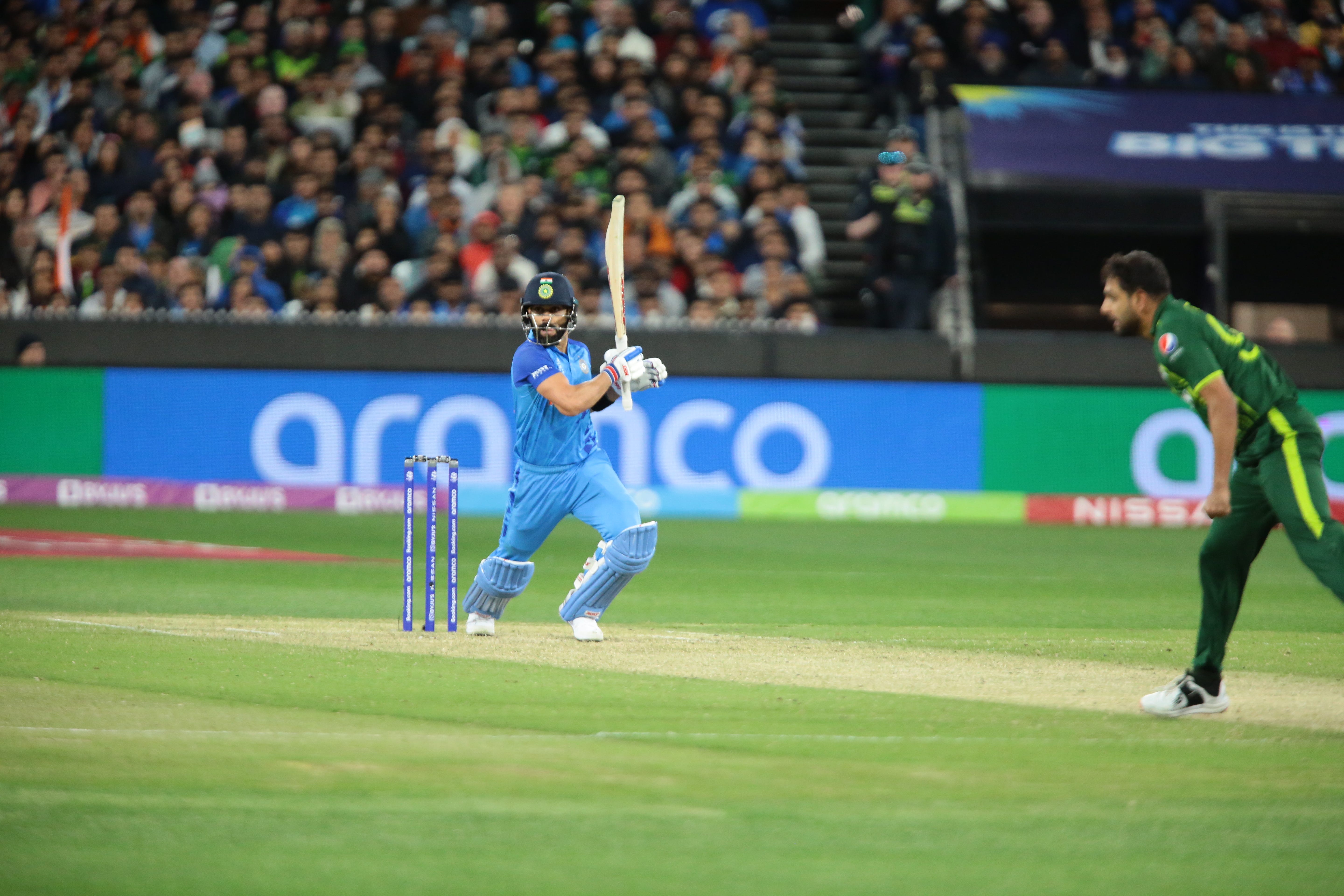
Now 13 from three balls, with R Ashwin to come in next. At the top of his mark, Nawaz thought about his options, and not one of these would have been the high full-toss that he ended up delivering. Kohli creamed it, sending the ball into the stands over deep square leg.
Now it’s six needed from three and Kohli can finally exhale. The high full toss has been called a no-ball and in free-hit territory, anything goes. Kohli sweeps and misses, the ball crashes into the stumps and the zing bails light up their red warning sign, but the batsmen have run three in the meantime. These are byes, but, as commentators like to say at times like this, it doesn’t matter where the runs come from.
Only two needed off two and DK is on strike. From here it’s surely India all the way. Except, a ball sliding down leg gets a hard sweep from Karthik and via pad and probably the bottom of the glove, the ball goes to Mohammad Rizwan, who can take the bails off as the batsman takes a speculative gander outside the crease.
One ball left, two to win it, one for a Super Over and Ashwin is at the crease. A dart into the stumps would have been ideal, but Nawaz, follows though a bit too much in delivery stride and the ball slips down leg. Many batsmen may have been heaving at this one, perhaps getting pad in the way, but Ashwin is standing tall, tucking himself inside the line and allowing the umpire to do his job for him, calling the ball a wide.
And again, one needed off one ball. Babar Azam, Pakistan’s captain, has little choice but to call the field in. All but one fielder, at midwicket, is inside the ring, trying to save the single and force a tie, for the batsmen are going to run irrespective of whether bat meets ball or not.
Here again, Ashwin’s cricketing intelligence comes to the fore. The ball is full, attacking the stumps, but Ashwin has gone right back in his crease to allow himself to convert what might have been a yorker into a ball that he can get under and chips over the infield.
All hell breaks loose. India have won, in the last ball of the game. Kohli is moved to tears, something we have not seen yet in his time as an India player. He thumps the ground with his gloved fist and Axar Patel is the first to sprint out to the middle to embrace his mates. Rohit is on soon after and hoists Kohli up in the air.
The records will show that Kohli was unbeaten on 82 off 53 balls, with six fours, four sixes and a strike rate of nearly 155. But they will not tell the tale of how one man believed in himself, refused to yield and conjured up a miraculous win.
Faith, belief, confidence. This is after all the hard work has been done and the skills have been worked on for decades. Sounds like a simple mantra for success in any walk of life.
It’s not rocket science, but it’s harder than that to implement and live, day in and day out.
This is why there is literally just one word to say to Kohli on the day: respect.